Archives
October 2016
AuthorInnovation is my life. Always learning. Always connecting. Join the conversation. Categories |
Back to Blog
The Biggest Short10/20/2016  The Ascendance of Artificial Intelligence The 2004 movie i-Robot engaged us in imagining our future relationship with intelligent robots. In one powerful scene, Sonny, the next generation NS-5 robot, stands on a hill surveying the prior generation robots imprisoned below. A generation eclipsed by technology. Relegated to low cost storage in shipping containers. This dystopian view may indeed be our future. But not as foreseen in the movie. As artificially intelligent robots and driverless cars increasingly displace us from employment, Universal Basic Income schemes are being devised to deal with large scale human obsolescence. Politicians envision low cost 3D printed ‘shipping containers’ as a viable housing solutions to stretch the diminishing tax payer dollar. A generation eclipsed by technology. Relegated to low cost storage in shipping containers. A Path Well Worn Artificial Intelligence is an amplification of technology we have grown comfortable with. According to Klaus Schwab in his book “The Fourth Industrial Revolution”, the top three companies in Silicon Valley now produce in revenue what the top three companies did in Detroit in the 1990’s. But with approximately 90% less employees. We gratefully accept today the convenience and benefits the technology age has delivered. We revere people like Steve Jobs whom augmented our lives with useable technology. Artificial Intelligence holds the promise to amplify a similar quantum improvement in productivity. While today we unknowingly use Artificial Intelligence every day, we fear its implications for all the right reasons. How does it work? Artificial Intelligence has arisen from the intersection of three exponential technology laws. Moore’s Law, Metcalfe’s Law and Kryder’s Law. An abundance of processing, connectivity and data has given rise to algorithm using enormous amounts of data to make decisions. These self-morphing, self-programming algorithms continuously simulate logic and learn scenarios. Like a child, deep learning embeds knowledge so it can focus on learning new things. It does this at speeds only limited by processing power. In simple terms according to Moore’s Law, Artificial Intelligence doubles it’s ‘intellectual capacity’ every eighteen months. Better, faster, cheaper. Great promise. Great risk. Like all breakthrough technologies, there is great promise. And great risk. With increasing frequency and velocity there are major scientific discoveries. Breakthroughs in cancer detection and treatment. Breakthroughs to help the paralyzed walk. The blind to see. Science fiction of the past, evolving in our present. At a speed and scale unprecedented in history. Driverless cars hold the promise of decimating road fatalities. According to World Health Organization, we lose over a million lives per annum globally on our roads. Yet this human benefit belies a human cost. Millions of people will lose their employment in exchange for the lives we preserve. Morally we may argue a small price to pay. Ethically and societally we may think a price too high. In the Obama administration’s October 2016 paper on Preparing for the Future of Artificial Intelligence, there is very clear identification of the potential for widening of economic and social inequality. According to Frey, C. B. and Osborne, M. A. (2013), The Future of Employment: “OECD data shows on average 57% of jobs are susceptible to automation, this number rises to 69% in India and 77% in China”. While there is a significant gap between potential and actual, there is no doubt that both income and employment gaps will widen significantly. Are we ready? Our ability to analyse data at scale raises legal, regulatory and ethical questions. Our search query data alone is 99.999% accurate in diagnosing pancreatic cancer at a point where medical intervention could triple the life expectancy of the unsuspecting user. But we choose to remain quiet and watch people die rather than breach regulated privacy. The precision of technology challenges the ambiguity of our humanity. The impact of machines taking over decision making fundamentally challenges our regulatory and legal system. If a driver car kills a pedestrian in a car accident to save the passengers, we empathise. No time to react. It was an accident. It was unavoidable. We imagine ourselves in that position. If a machine were to calculate an outcome, we see it as calculating. In law, calculation is the difference between manslaughter and murder. Our expectation of technology is precision and record. We expect the black box to unravel the mystery. But Artificial Intelligence algorithms are as dynamic as our thoughts. They evolve continuously as they learn, challenging regulators and the legal community to determine what they were ‘thinking’ at the time of incident. In the case of Tesla’s crash, investigators initially struggled to determine which technology was in charge at the time of the crash. We persist with the technology because the accident rate is already well below that of human drivers. We must not let perfect prevent progress. Our Future Whilst it is easy to visualize the impact of driverless cars on jobs, unlike prior technology revolutions, the impact of Artificial Intelligence goes beyond entry level jobs. Accountants, doctors, lawyers, actuaries and auditors will all have various elements of their jobs augmented or potentially replaced. If it is technical and repeatable, it is an obvious candidate for replacement. The irony being, doctors may be more at risk than nurses in displacement by Artificial Intelligence. The simple truth according to Drew Perez, CEO of Adatos is “Don’t send in a man to do a machines job.” The big question is ‘are prepared? While technology advances at ever accelerating speed, our mechanisms to cope continue to evolve at more modest human rates of change. Politically, economically and socially. If the movie ‘The Big Short’ focused attention on the fragility of our financial system, what happens when millions can’t pay their mortgages again because their roles have become obsolete? While the promise of Artificial Intelligence for good is powerful, the dangers are worthy of public investment attention and scrutiny. As Joi Ito so eloquently articulated “This year (2016), artificial intelligence will become more than just a computer science problem. Everybody needs to understand how AI behaves.”
1 Comment
Back to Blog
Is Strategy Dead?11/14/2015 
|
 RSS Feed


 In 1920, the lifespan of a Standard and Poors Top 500 company was 67 years. By 2010, that had dropped to just 15 years. And by 2013, corporate lifespans had deteriorated below 10 years. By any measure a pandemic. Very simply, when the rate of change outside a corporation exceeds the rate of change inside an organization, chances of survival diminish. While most companies talk about the need for an innovation culture, the reality is we need an adaptation culture. We need some people pushing boundaries with innovation. Equally we need people focused on core execution. Re-engineering a plane in flight requires balance. Ying and Yang. Universally, we need to have an organization prepared to adapt to changing customer demands and innovation opportunities. Intrapreneurs face onerous challenges. Surrounded by resource, corporations are forever resource constrained. The challenge in innovation is as much to kill as it is to create. To be able to refocus resource from platforms in decline to platforms in demand. In the words of Warren Buffett, “The power of simple math is often ignored by companies to the detriment of their shareholders”. In one institution I observed we were spending seven times more on platforms in decline than platforms in demand. Simply, we were failing to invest in what customers value. In those terms, it is easy to see why the world’s leading corporations are failing faster than ever before. Success has it’s own inertia and can be your greatest enemy. The momentum of success is perhaps the hardest challenge for an intrapreneur to overcome. With crisis comes commitment. But the absence of a crisis creates a conundrum. Why change something that is working well? Not everyone sees what you see. So I’ve developed a simple formula for change over the years. ICE. Inspire, Collaborate and Execute. Inspire is about providing the organization context. Context that defines the call to action. An ‘outside in’ approach of starting with the customer and looking across industries for best in class customer centric transformation. Developing an ecosystem of expertise from Government, Universities, Entrepreneurs and giving voice to change leaders within. For reasons difficult to understand, voices from outside resonate more loudly than those from within. But your change leaders are your catalysts for transformation. Collaborate is to enable the ecosystem to function. Building capabilities to support initiatives. Skills such as Design, Agile Development and Lean Management. It is important to light fires across the organization using your champions as catalysts. Nothing is more powerful than aligning a team. Doing the right thing, the right way with the right people. Execute is simply about focus. Identifying the one critical pivot point that will contribute to your current core but over time transform your business model. History across many industries has shown, transformation at the core often meets too much resistance to succeed. Transforming an adjacency or creating your own competitor has a higher probability of success. Intrapreneurs have what Entrepreneurs crave. Capital and resource. But the constraints around capital and resource within the corporation often make that advantage difficult to attain. The consistent advantage intrapreneurs have is access to brilliant minds. Internally and externally. As the world changes to more collaborative ecosystems, the lines between intrapreneurialism and entrepreneurialism will become less defined. But the imperative to change will grow stronger. To paraphrase Charles Darwin, it’s not the biggest or the strongest corporations that will survive, but the ones most adaptive to change. |
Back to Blog
Question
9/4/2014
At the center of tech innovation lies three core laws. Moore's Law, Metcalf's Law and Kryder's law. Intelligence, Connection and Data. As I continue to explore innovation I've drawn two conclusions and one big question I struggle with.
Observations
1. Big Data: Information is a commodity. But insight is invaluable.
2. Social: Connection is a commodity. But conversation is invaluable.
Question
1. Intelligence: What happens when intelligence is a commodity?
Your insight greatly appreciated!
Steve
Observations
1. Big Data: Information is a commodity. But insight is invaluable.
2. Social: Connection is a commodity. But conversation is invaluable.
Question
1. Intelligence: What happens when intelligence is a commodity?
Your insight greatly appreciated!
Steve
THE FOUNDATIONAL LAWS OF TECHNOLOGY AND DISRUPTION
Back to Blog

Innovation: Not today, we're too busy.
3/14/2014
Life or Death
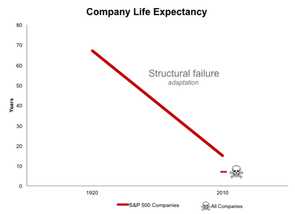
It’s a familiar refrain. Not today, we’re too busy. Whether too busy because times are good. Or too busy because times are bad. Apparently there is never a good time to stop, listen, think and act with fresh perspective. It shows. In 1920, our strongest companies in the S&P lived for 67 years. By 2010 they average only 15 years. The average across all companies, just 8 years.
Companies are dying as kids
Judging by results, our investments in education, training and building corporate culture have been wildly misdirected. Our customers are changing. Clearly corporations and institutions aren’t changing with them. It’s easy to see if we just take the time to look. To challenge our existing beliefs. To understand why we do what we do. Why we believe what we believe. It’s easy to see why we miss the obvious.
It’s a familiar refrain. Not today, we’re too busy. Whether too busy because times are good. Or too busy because times are bad. Apparently there is never a good time to stop, listen, think and act with fresh perspective. It shows. In 1920, our strongest companies in the S&P lived for 67 years. By 2010 they average only 15 years. The average across all companies, just 8 years.
Companies are dying as kids
Judging by results, our investments in education, training and building corporate culture have been wildly misdirected. Our customers are changing. Clearly corporations and institutions aren’t changing with them. It’s easy to see if we just take the time to look. To challenge our existing beliefs. To understand why we do what we do. Why we believe what we believe. It’s easy to see why we miss the obvious.
Adapt and Migrate
Asia has 895 million mobile web users. Growing at 45% per annum. Yet few companies really comprehend this shift. I see major institutions in Asia still without a mobile strategy. Dig a little deeper, I’ve seen institutions spending 7x more on platforms in decline than in mobile platforms which are fast becoming the primary channel. Think about it. Investing 7x more in decline than growth.
No wonder companies are dying as kids.
The rationale sounds reasonable. ‘You don’t understand, our customers are not sophisticated’, ‘You don’t understand, our business is complex’ etc. Always a safe argument. Innovation inherently comes with risk. What is clear, simply many companies don’t understand their customers.
Worse still, they underestimate their customers.
The modern mobile is the equivalent of USD3.5 Million worth of computing power in 1991. The computational power is more than NASA used to put man on the moon in 1969. Millions of developers around the world are harnessing that power to mask complexity and deliver brilliant user experiences. Simplifying interactions believed impossible before. Consumers don't have to be sophisticated. They don't care about the plumbing. Just the experience.
The power is in their hands.
Asia has 895 million mobile web users. Growing at 45% per annum. Yet few companies really comprehend this shift. I see major institutions in Asia still without a mobile strategy. Dig a little deeper, I’ve seen institutions spending 7x more on platforms in decline than in mobile platforms which are fast becoming the primary channel. Think about it. Investing 7x more in decline than growth.
No wonder companies are dying as kids.
The rationale sounds reasonable. ‘You don’t understand, our customers are not sophisticated’, ‘You don’t understand, our business is complex’ etc. Always a safe argument. Innovation inherently comes with risk. What is clear, simply many companies don’t understand their customers.
Worse still, they underestimate their customers.
The modern mobile is the equivalent of USD3.5 Million worth of computing power in 1991. The computational power is more than NASA used to put man on the moon in 1969. Millions of developers around the world are harnessing that power to mask complexity and deliver brilliant user experiences. Simplifying interactions believed impossible before. Consumers don't have to be sophisticated. They don't care about the plumbing. Just the experience.
The power is in their hands.
Back to Blog
 Note: Every warrior is unique
Innovation Culture is Overrated
2/25/2014
Note: Every warrior is unique Innovation Culture
A common CEO refrain, "We need an innovation culture." Really? It's a bit like Life of Brian. "We're all individuals". Wouldn't it be great if everyone thought the same way?
While we say we are after an innovation culture, what we really need is an adaptation culture. Darwin was right. Derek Sivers was right. (http://www.ted.com/talks/derek_sivers_how_to_start_a_movement.html)
Innovation Execution
We need innovation leaders to innovate and strong execution teams to adapt and evolve. To engage the customer. To engage the organisation. Having a vision for a new product or business is not the same as executing it. Dreamers dream. Builders build. Ideas are cheap, everyone has them. Execution is everything. Right brain, left brain. We need both to operate effectively as human beings. The same holds true for commercial organisations.
Innovation Distinction
While I firmly believe everyone is creative, not everyone is innovative. (http://www.ted.com/talks/ken_robinson_says_schools_kill_creativity.html). Innovation requires risk tolerant application. Like jumping out of a plane. Take the plunge ... but trust the guy who packed your parachute.
Steve Jobs didn't replicate himself into a culture. He aligned his organisation behind a common vision and recognised those who could contribute to delivery and those that could not (http://kensegall.com/insanely-simple-book/). He built a team who could get behind his ideas and standards and mould them into realistic deliverables. His core team, like Jonathan Ives, aligned behind the vision, adapted and contributed to deliver a greater outcome. We clearly recognise the contribution. The sum of the deliverable exceeded the initial vision. Always the way.
Innovators don't create great companies. Teams do. Teams that can recognise an innovative concept, align behind it and adapt it to a market making deliverable. I'll take an adaptation culture over an innovation culture any day.
A common CEO refrain, "We need an innovation culture." Really? It's a bit like Life of Brian. "We're all individuals". Wouldn't it be great if everyone thought the same way?
While we say we are after an innovation culture, what we really need is an adaptation culture. Darwin was right. Derek Sivers was right. (http://www.ted.com/talks/derek_sivers_how_to_start_a_movement.html)
Innovation Execution
We need innovation leaders to innovate and strong execution teams to adapt and evolve. To engage the customer. To engage the organisation. Having a vision for a new product or business is not the same as executing it. Dreamers dream. Builders build. Ideas are cheap, everyone has them. Execution is everything. Right brain, left brain. We need both to operate effectively as human beings. The same holds true for commercial organisations.
Innovation Distinction
While I firmly believe everyone is creative, not everyone is innovative. (http://www.ted.com/talks/ken_robinson_says_schools_kill_creativity.html). Innovation requires risk tolerant application. Like jumping out of a plane. Take the plunge ... but trust the guy who packed your parachute.
Steve Jobs didn't replicate himself into a culture. He aligned his organisation behind a common vision and recognised those who could contribute to delivery and those that could not (http://kensegall.com/insanely-simple-book/). He built a team who could get behind his ideas and standards and mould them into realistic deliverables. His core team, like Jonathan Ives, aligned behind the vision, adapted and contributed to deliver a greater outcome. We clearly recognise the contribution. The sum of the deliverable exceeded the initial vision. Always the way.
Innovators don't create great companies. Teams do. Teams that can recognise an innovative concept, align behind it and adapt it to a market making deliverable. I'll take an adaptation culture over an innovation culture any day.
Back to Blog
New Age. New Stage.
2/23/2014
Porter defined strategy. Differentiation or cost leadership. Margin or market share. It used to be a choice. Dell defined low cost in the PC Industry and took the market. Apple later defined differentiation and took the market. Validation of Porter's strategy framework.
New Age. New Stage. Differentiation and cost leadership used to be considered mutually exclusive. No longer the case in the Information Age. Design is differentiation. Cost leadership is scale. Co-existance is the new norm and a powerful force. Today we design and scale experiences.
Simplicity and ease drive our experience. Simplicity is cognitive. Apple made technology so simple to use, it encouraged two new generations to embrace technology. The old and the young. Ease defines effort. Amazon made it so easy to shop, it continues to empty physical retail stores around the world.
Simplicity and ease go to the heart of human behaviour. It defines our experience. A powerful force for change. As we define our own innovation agenda, embracing these new rules of engagement are a foundation for success.
New Age. New Stage. Differentiation and cost leadership used to be considered mutually exclusive. No longer the case in the Information Age. Design is differentiation. Cost leadership is scale. Co-existance is the new norm and a powerful force. Today we design and scale experiences.
Simplicity and ease drive our experience. Simplicity is cognitive. Apple made technology so simple to use, it encouraged two new generations to embrace technology. The old and the young. Ease defines effort. Amazon made it so easy to shop, it continues to empty physical retail stores around the world.
Simplicity and ease go to the heart of human behaviour. It defines our experience. A powerful force for change. As we define our own innovation agenda, embracing these new rules of engagement are a foundation for success.